
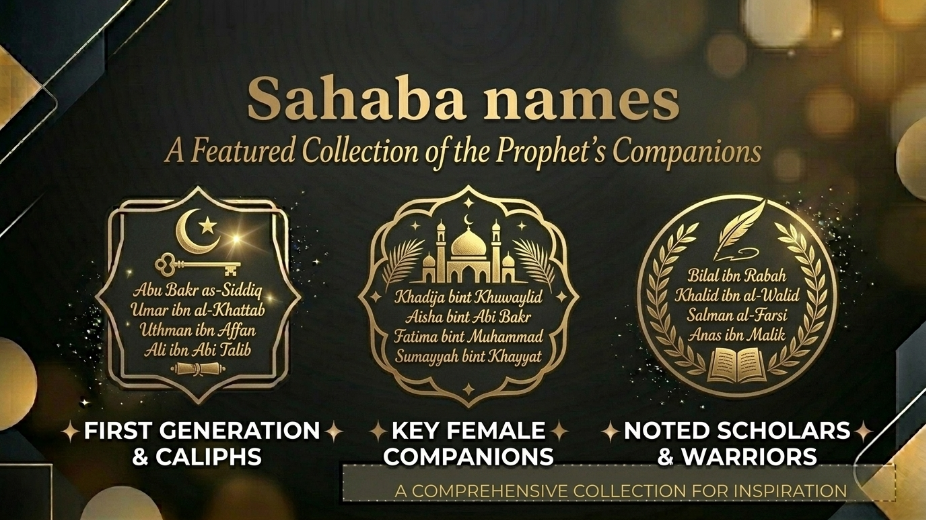
When people search for “sahaba names”, they are usually looking for the names and identities of the noble companions of Prophet Muhammad ﷺ. The Sahaba (Companions) hold a very special place in Islam because they were the first believers who supported the Prophet during the early days of Islam in Makkah and Madinah. They played a key role in spreading the message of Islam and preserving the teachings of the Qur’an and Sunnah.
Understanding sahaba names is important for Muslims, students, and anyone interested in Islamic history because it helps us learn about courage, faith, sacrifice, and leadership. Many people search for these names for Islamic studies, baby naming ideas, or general knowledge. In this article, you will learn the meaning of Sahaba, their importance, and a detailed list of famous companions along with their contributions in Islam.
What Does “Sahaba” Mean?
The word “Sahaba” (صحابة) is an Arabic term that means:
- Companions
- Friends or followers of Prophet Muhammad ﷺ
- Those who saw, believed in, and followed the Prophet during his lifetime
Simple Definition:
A Sahabi (singular) is a person who:
- Met Prophet Muhammad ﷺ
- Believed in him as the Messenger of Allah
- Died as a Muslim
Importance of Sahaba in Islam
The Sahaba are among the most respected people in Islamic history.
Why they are important:
- They directly learned Islam from Prophet Muhammad ﷺ
- They preserved the Qur’an and Hadith
- They spread Islam across Arabia and beyond
- They showed strong faith during hardships
- They sacrificed wealth, family, and life for Islam
Without the Sahaba, Islamic teachings would not have reached us in the same way.
Categories of Sahaba Names
Sahaba can be divided into different groups based on their roles:
1. Khulafa-e-Rashideen (Rightly Guided Caliphs)
These are the first four leaders after the Prophet ﷺ:
- Abu Bakr Siddiq (RA)
- Umar ibn Khattab (RA)
- Uthman ibn Affan (RA)
- Ali ibn Abi Talib (RA)
2. Famous Male Sahaba
- Hamza ibn Abdul-Muttalib (RA)
- Bilal ibn Rabah (RA)
- Saad ibn Abi Waqqas (RA)
- Salman al-Farsi (RA)
- Abu Huraira (RA)
3. Famous Female Sahaba
- Khadijah bint Khuwaylid (RA)
- Aisha bint Abu Bakr (RA)
- Fatimah bint Muhammad (RA)
- Umm Salama (RA)
- Asma bint Abu Bakr (RA)
Detailed List of Famous Sahaba Names
Here are some of the most well-known Sahaba names with brief descriptions:
Abu Bakr Siddiq (RA)
- First Caliph of Islam
- Closest companion of the Prophet ﷺ
- Known for truthfulness and loyalty
Umar ibn Khattab (RA)
- Second Caliph of Islam
- Known for justice and strong leadership
- Expanded Islamic empire significantly
Uthman ibn Affan (RA)
- Third Caliph of Islam
- Known for generosity
- Compiled the Qur’an into a single book form
Ali ibn Abi Talib (RA)
- Fourth Caliph of Islam
- Cousin and son-in-law of Prophet ﷺ
- Known for bravery and wisdom
Bilal ibn Rabah (RA)
- First Mu’azzin (caller to prayer) in Islam
- Known for patience and faith under torture
Hamza ibn Abdul-Muttalib (RA)
- Uncle of Prophet Muhammad ﷺ
- Known as “Lion of Allah” for bravery in battle
Salman al-Farsi (RA)
- Persian companion of Prophet ﷺ
- Known for wisdom and seeking truth
Abu Huraira (RA)
- Famous narrator of Hadith
- Reported thousands of sayings of the Prophet ﷺ
Famous Female Sahaba Names and Their Role
Khadijah bint Khuwaylid (RA)
- First wife of Prophet Muhammad ﷺ
- First person to accept Islam
- Supported Islam with wealth and strength
Aisha bint Abu Bakr (RA)
- Wife of the Prophet ﷺ
- Known for knowledge and teaching Hadith
- One of the greatest female scholars in Islam
Fatimah bint Muhammad (RA)
- Daughter of Prophet ﷺ
- Known for purity, patience, and strong faith
Asma bint Abu Bakr (RA)
- Known for courage during Hijrah (migration)
- Helped the Prophet ﷺ and Abu Bakr (RA) secretly
Sahaba Names and Their Role in Islamic History
The Sahaba played a major role in:
1. Spreading Islam
They traveled to different regions to spread Islam.
2. Protecting the Prophet ﷺ
They defended him in battles like:
- Battle of Badr
- Battle of Uhud
- Battle of Khandaq
3. Preserving the Qur’an
They memorized and wrote down the verses of the Qur’an.
4. Teaching Islam
After the Prophet ﷺ passed away, they taught Islam to new generations.
Sahaba Names Often Used as Baby Names
Many Muslim parents choose Sahaba names for children because of their Islamic value.
Popular boy names:
- Umar
- Ali
- Hamza
- Bilal
- Saad
- Usman
Popular girl names:
- Aisha
- Fatimah
- Khadijah
- Asma
- Zainab
These names carry blessings and historical importance.
Common Misunderstandings About Sahaba Names
1. Sahaba are not prophets
They are companions, not prophets.
2. Not all Sahaba are equally famous
Some Sahaba are well-known, others are less documented.
3. Sahaba names are not just historical
They are still widely used today in Muslim families.
Why People Search for Sahaba Names
People search “sahaba names” for:
- Islamic education
- School assignments
- Baby naming ideas
- Religious knowledge
- Learning Islamic history
Modern Relevance of Sahaba Names
Even today, Sahaba names remain popular because:
- They represent strong Islamic identity
- They inspire moral values
- They are used worldwide in Muslim communities
- They connect Muslims to early Islamic history
FAQs
1. What are Sahaba names?
Sahaba names are the names of the companions of Prophet Muhammad ﷺ who supported and followed him.
2. How many Sahaba are there?
There were thousands of Sahaba, but about 1500–2000 are well recorded in Islamic history.
3. Who is the most famous Sahaba?
Abu Bakr Siddiq (RA), Umar ibn Khattab (RA), Uthman ibn Affan (RA), and Ali ibn Abi Talib (RA) are the most famous.
4. Why are Sahaba important in Islam?
Because they preserved Islam, learned directly from the Prophet ﷺ, and spread the message worldwide.
5. Can Sahaba names be used as baby names?
Yes, many Sahaba names are commonly used as Muslim baby names today.
Conclusion
Sahaba names represent the noble companions of Prophet Muhammad ﷺ who played a key role in shaping Islamic history. They were brave, faithful, and deeply committed to spreading Islam. Learning about Sahaba helps us understand the early struggles of Islam and inspires us to live with honesty, patience, and faith.
Today, these names are still widely used in Muslim families as a way to honor their legacy and keep their memory alive. Whether for education, inspiration, or naming children, Sahaba names carry deep spiritual and historical value.
